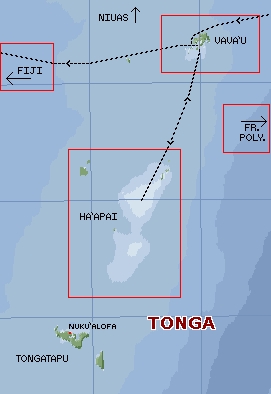
The Kingdom of Tonga - click on a section of the map to see that page
|
Pacific Landfalls Tonga Pages Related Pages |
Kingdom of Tonga
The Kingdom of Tonga - click on a section of the map to see that page |
| Language: | Tongan, primarily, but everyone learns English in school |
| Population: | Around 100,000. Mostly Tongans (who are Polynesian) but a small population of palangi (foreigners) from Europe, New Zealand, and Australia. A few immigrants from China. No Indians are allowed in. |
| Money: | There were about 2 Pa'anga (Tonga dollars) per US dollar in 2004 |
| Landscape: | Tonga lies west of the Tongan Trench, on the Indo-Australian plate. Most of Tonga's high islands were created recently, geologically speaking. The new crust that the north-south-lying islands are on sags under the weight of the two volcanoes just to the west of the Ha'apai Group: Kao and Tofua. This pushes the Ha'apai Group lower, and juts the Vava'u and Tongatapu groups higher on their north and south sides, respectively, resulting in tall cliffs on those coasts. The islands closer to the volcanoes and the Ha'apai group are thus low to the water, and have many coral mazes underwater. |
| Visited: | 19 May until 4 October, 2004 |
| Track Files: | Further down this page |
Be sure to check out our Newsletters sent from Tonga for more info and photos.
Mythology: Several legends exist as to how the Tongan Islands came to be, but the most common ones are rather similar. A Polynesian god (stories range from Tangaloa to Maui) was fishing in the sea, and the fish-hook snagged on the islands and yanked them up. In Tangaloa's story, they all came up as one island, but the fishing line snapped and the island sank slightly, leaving the separate islands of the Vava'u Group. The story of Maui is that he was fishing with a hook loaned to him by a man named Tonga. He pulled up the islands one by one, and named the largest after the man who had made the hook.
Cruisers: We are now publishing Downloadable Track Files in OpenCPN (.gpx) format and in MaxSea (.ptf) format (not all tracks are available in all formats yet - we're still working on it and they take time). You can download the track files either by clicking on the links in the tables below, or by clicking on the track in the Google Map below the table. The MaxSea files are in native format but the OpenCPN files are zipped so they download faster, and they need unzipping after they've been downloaded (which most operating systems do natively). If 2 files are shown, the smaller one has been edited to remove redundant points from straight tracks. This improves the speed of the download as well as performance once the file is loaded. Sometimes MaxSea Track files are separated from the Mark (chart notations) files. Download instructions are provided if you need them.
These files are provided free and we are actively soliciting cruisers to send us your track files so we can post them for others to download. If you would like to to participate, please email us your track files (as attachments to our HackingFamily account, not our Winlink acct) along with your boat name and draft. If you include your website and boat details, we'll link back to you from our Cruising Links page.
Disclaimer: While we always try to provide useful information, we can take no responsibility for its accuracy or usefulness. Prudent mariners will always navigate using all means at their disposal, and will not rely solely on electronic navigation.
|
Tonga Tracks
History: Tonga was first settled from the west - the East Indies or the Philippines - and it's theorized that it was among the first Polynesian settlements. Mu'a was finally, if not initially, chosen as the capital (on Tongatapu) because of its protection and access to the sea. The Tongans were initially like the Fijians, in that they believed creating war and strife to be a worthy pastime. At one point, the Tu'i Tonga's (king's) area of reign included the Lau Group of Fiji, Niue to the east, and Samoa & Tokelau to the north. The first European contact with Tonga was in 1616, when two Dutchmen encountered a Tongan canoe near the Niuas, resulting in several killed and captured Tongans. The next encounter was more fortuitous to both sides; Abel Tasman, another Dutchman, traded in Tongatapu and landed in the Ha'apai. The Kingdom of Tonga ironically acquired the name "The Friendly Islands" from Captain Cook in 1777, on his third visit. The Ha'apai locals had prepared an enormous feast for the sailors, which was, unbeknownst to them, to be the lure for a plot to kill the Englishmen and take all their goods. The plan went awry, however, through a miscommunication between the nobles. None of the previous Europeans had visited the Vava'u Group, so the "discovery" of those islands was left to a Spaniard, Don Francisco Mourelle. He claimed the group for Spain, but because of concerns in the Americas, Spain didn't follow up. Missionaries first arrived in Tonga in 1797, the first permanent European "settlers" - deserters from an American ship - having arrived only a year before. Cannibalism still being common, missionaries did not come again to the islands until 1822, when a Wesleyan minister arrived in Tongatapu. He returned to Australia for a while, but eventually the Tongans indicated an interest in Christianity, and Wesleyans met with great success when next they went to Tonga. They converted most of the kings, and through them, most of the people of Ha'apai and Vava'u. Upon the deaths of the kings of Tongatapu and Vava'u, Tu'i Tonga Taufa'ahau of Ha'apai acquired their titles as well, and became the ruler of a united Tonga under his Christian name of King George Tupou I. With the help of Reverend Shirley Baker, the King of Tonga achieved a great governmental reform. Much to the annoyance of the missionaries, they created a flag, a state seal and national anthem, and a full constitution which was passed on November 4th 1875. Baker soon was appointed the Prime Minister of Tonga, and created the Free Church of Tonga. He had been dissociated from the Wesleyans a few years before, in 1879. When King George urged his (Wesleyan) subjects to join the Free Church, a small holy-war resulted in many remaining Wesleyans emigrating to Fiji. Britain entered Tonga's history at this point, convincing King George that religious freedom was necessary, and eventually Shirley Baker was deported. Britain became Tonga's protector in foreign affairs when King George's great-grandson (King George Tupou II) assumed the throne. He died in 1918, and his daughter Salote became queen (at age 18). Queen Salote was unlike her two predecessors in that her main concerns were health and education. Because of her compassion for these subjects, rather than religion, she captured the hearts of subjects and foreigners alike. Her presence at Queen Elizabeth II's coronation - riding in an un-covered carriage through an English downpour - is known throughout the world. Tonga attempted to go democratic in the early 1990's, and the Tongan Pro-Democracy Movement was going strong for quite a while. The monarchy holds all the keys, however, and the movement was slapped down in 1992. After a 12-day sail (see Tonga Newsletters) from Maupiti, in French Polynesia, we arrived in Neiafu, Tonga, the day before Jon and Sue's 25th wedding anniversary. The main attraction for us in Tonga was the cruising boat Lady Starlight, with their two teenagers aboard. Luckily the two families hit it off, and we ended up staying in Tonga for more than 4 months. We explored many of the anchorages in the Vava'u Group, spent many days moored off the town of Neiafu, and ventured south to the wild islands of the Ha'apai Group for a couple weeks in July and August. We also did lots of scuba diving, both on our own and with a commercial dive center, Dolphin Pacific Diving. Tonga Pages:
Related Pages:
Pacific Destinations:
Top Level: Home | Destinations | Cruising Info | Underwater | Boat Guests | Ocelot | Sue | Jon | Amanda | Chris | Site Map | Make a Comment
Copyright © 2000‑ Contact: Jon and Sue Hacking -- HackingFamily.com, svOcelot.com. All rights reserved. |