by Pratt, Burner, and Berrett, 520 pages.
|
Flora & Fauna Areas Fr. Polynesia Flora Related Pages |
Fr. Polynesia Flora/Fauna
| Want to travel to French Polynesia? Most travelers enter French Polynesia via the international airport in Tahiti, from which they can fly east to the Marquesas or the Tuamotus, or west to the other Society Islands such as Moorea and Bora Bora. Sailboats can be charted in the major islands (Tahiti and Raiatea) allowing access to smaller islands without airports. Cars can be rented on most of the Society Islands (Tahiti to Bora Bora). Bicycles are a good option on all but the largest islands. Hiking is a great way to get into the forests of the Marquesas. |
This section highlights some of the interesting flora and fauna -- plants, animals and birds -- of the islands of French Polynesia. This includes the island groups of the Marquesas, the Tuamotus, and the Society Islands which include Tahiti, Moorea and Bora Bora.
Located approximately 3,500 miles from the South American continent, and about the same distance from the Australian continent, the French Polynesian islands almost define the word "isolation." After the astounding wildlife of the Galapagos, French Polynesia seemed somewhat sterile in terms of birds and land animals. The plants, however, are as varied and magnificent as those of the Eastern Caribbean, and the underwater life is bountiful and exciting.
Binoculars and camera in hand, we spend many hours exploring our environment. On board, we use several valuable reference books to terrestrial flora and fauna:
A Field Guide to the Birds of Hawaii and the Tropical Pacific
Seabirds: An Identification Guide
A Naturalist's Guide to the Tropics
Collins Guide to Tropical Plants
And, less technical, but easy reading and full of anecdotes is the
Lonely Planet guide to Tahiti & French Polynesia
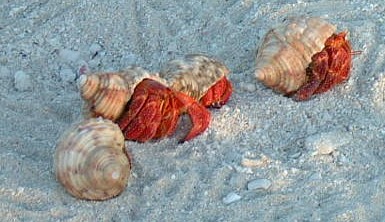
The largest land animals are the small yellow geckos that inhabit the trees and eaves of the island homes. Large, nocturnal coconut crabs leave evidence of their existence by their 8‑12" (20‑30 cm) holes in the sand. More obvious are the hermit crabs which scuttle about on the sandy shores scavenging for food and new and better shells to inhabit. There are no dangerous land animals and no snakes in French Polynesia. |
 |
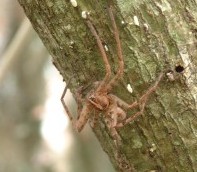 |
While hiking over the top of Moorea with friends Karen and Jon, we suddenly heard Jon yelp. A 3" brown spider had launched itself onto his collar from one of the Tahitian chestnut trees. He didn't let it sit on his shoulder long enough to prove that "there are no poisonous spiders in French Polynesia." |
| While driving around Huahine (in the Society Islands) we came upon a stream in which live the islander's sacred blue‑eyed eels. We thought we would be lucky to find an eel. To our surprise, about a dozen of the 2‑3 foot brown eels emerged from behind a retaining wall to check out the bread crumbs we tossed on the water. Fresh water eels (and crabs) can be found in most of the Society Islands streams. | 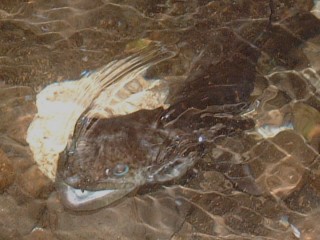 |
BIRDS of French Polynesia
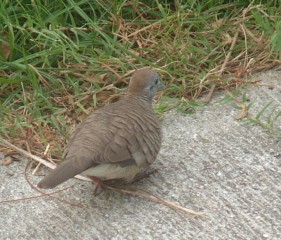 The tiny, blue-faced Zebra Dove |
The bird life in French Polynesia is scant compared to the Americas, or Australia, with introduced species slowly pushing out the endemic land birds. In 1903 the aggressive Indian myna was imported to help wipe out a beetle. It has also wiped out several endemic birds by robbing their nests. The island of Maupiti (the western-most inhabited island in the Society Islands) brags more native birds than elsewhere due to the lack of mynas. In addition to the mynas a few song birds can be seen flitting from branch to branch such as the red-vented bulbul, common waxbill, chestnut-breasted mannikin, and silvereye. A very common companion along trails and roadsides was the tiny blue faced zebra dove, not endemic, but introduced from Australia to Tahiti in 1950. It is also known as the barred or peaceful dove.
More than 27 species of sea birds migrate to and from the islands, though a few do nest here. Commonly seen over the anchorages are magnificent frigate birds, the all-white fairy terns, great terns, and black and brown noddies with a distinctive white patch on the head. Other avian friends of ours from the Galapagos are the red-footed boobies and masked boobies.
For bird identification in French Polynesia we generally used two books:
Seabirds: An Identification Guide
A Field Guide to the Birds of Hawaii and the Tropical Pacific
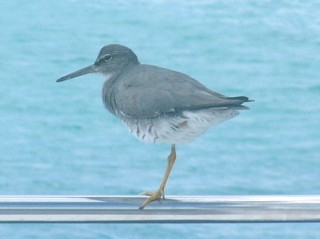 The wandering tattler is a commonly seen
migratory shorebird, arriving in the northern winter from Alaska and NW
Canada. It feeds on rocky shores by running and probing, while
characteristically bobbing its tail. One took a long break from feeding
to rest on the bow rail of Ocelot one afternoon in Raiatea.
The wandering tattler is a commonly seen
migratory shorebird, arriving in the northern winter from Alaska and NW
Canada. It feeds on rocky shores by running and probing, while
characteristically bobbing its tail. One took a long break from feeding
to rest on the bow rail of Ocelot one afternoon in Raiatea. |
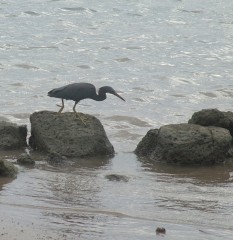 The Pacific reef heron
is occasionally seen standing very still on the water's edge. Similar to
the Little blue heron, the Pacific reef heron has a more crouched stance
and yellow-greenish legs. It is often solitary, but nests ashore in
small groups on rocky ledges or trees. It occurs throughout French
Polynesia.
The Pacific reef heron
is occasionally seen standing very still on the water's edge. Similar to
the Little blue heron, the Pacific reef heron has a more crouched stance
and yellow-greenish legs. It is often solitary, but nests ashore in
small groups on rocky ledges or trees. It occurs throughout French
Polynesia. |
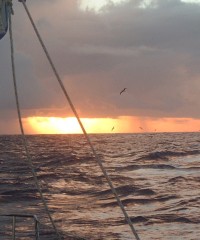 |
Boobies and frigate birds soar and circle above the
sea in the late afternoon. This shot was taken on the day we left Maupiti
to sail to the Kingdom of Tonga.
We occasionally saw sea birds hundreds of miles from land. Most were petrels or shearwaters. They are very difficult to positively identify while on the wing, at sea. |
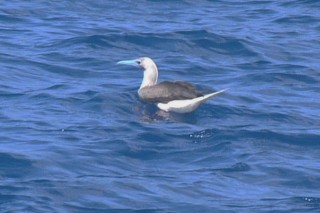
| A red-footed boobie rests on the ocean between acrobatic flights and dives to capture a meal just outside the reef in Bora Bora. Despite their name which implies a clown-like appearance and demeanor, we find the boobies to be graceful and strikingly beautiful with their blue faces, clearly delineated feather colors, and bright red feet. Also common in the islands are the brown boobies with their brown heads, back and wings, and white breast. They, too, have light blue on their bills, but less than the red-footed boobies. |
 |

Top Level: Home | Destinations | Cruising Info | Underwater | Boat Guests | Ocelot | Sue | Jon | Amanda | Chris | Site Map | Make a Comment
|
If our information is useful, you can help by making a donation |
Copyright © 2000‑ Contact: Jon and Sue Hacking -- HackingFamily.com, svOcelot.com. All rights reserved.