Caracas is the gateway to Venezuela and is accessible by flights from Europe and the USA, as well as the rest of South America. Many international flights also fly to Margarita Island directly.

Wood Storks in formation over Los Llanos
|
Flora & Fauna Areas Venezuela Flora/Fauna Related Pages Venezuela Home |
Venezuela Birds
| Want to go Birding in Venezuela?
For coastal and sea birds take a boat charter out of Margarita or Los Roques
or spend time on Margarita Island. To see the birds of the Andes and Los
Llanos, nature tours and birding trips originate in Merida. There are
many daily flights from Caracas to Merida. For toucans and jungle birds,
fly to Canaima National Park, home of Angel Falls. Caracas is the gateway to Venezuela and is accessible by flights from Europe and the USA, as well as the rest of South America. Many international flights also fly to Margarita Island directly. |
Wood Storks in formation over Los Llanos |
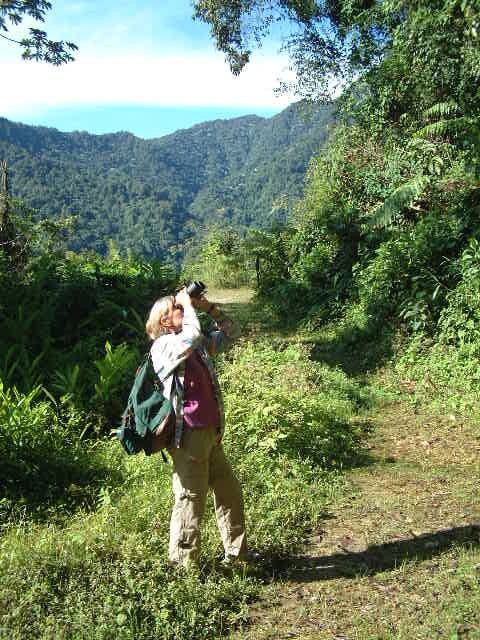 |
Venezuela! A birders paradise!!
We've been able to continue using
A Guide to the Birds of the West Indies We took a wildlife safari into Venezuela's interior: an area called Los Llanos (the plains) which is really as close to Botswana's Okavango Delta in Africa as one can get in terms of the area being a bird haven, half the year flooded, half dry. We visited at the end of the wet season, meaning there were still many flooded grasslands filled with birds and we could travel up Venezuela's Apure River and its smaller tributaries by long metal canoe (with outboard). |
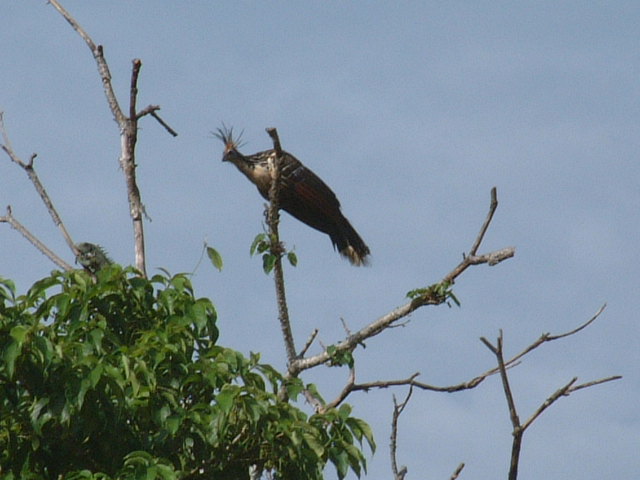
| The Hoatzin Bird of Venezuela is unique in that the young have claws on their wings, like ancient archaeopteryx . Until a few weeks old the young fall from their nests when threatened, landing in the river water in which they swim until it is safe to come up. Then they climb the tree trunk with their claws and return to the nest! We saw dozens and dozens of hoatzin birds along the Apure River. |
 |
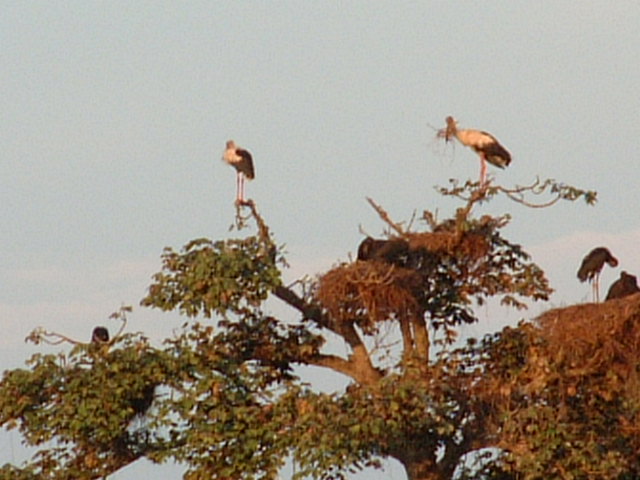 |
Maguari Storks, standing about 1m (40in) high are found throughout the tropical zone of Venezuela, and south to Argentina. They build large nests of sticks in palms or low trees, often near heron colonies. They feed on reptiles small mammals, frogs and insects. |
|
Venezuelan mystery bird now identified, thanks to Rasmus Boegh who emailed
us. He says this is a Troupial, which he can tell by the hood,
the perching, the jizz (overall look), and the orange belly. The Troupial is the national bird of Venezuela but it can be tricky to
ID in certain light conditions. (Previously we had written: This may be the Rufous-bellied Euphonia, though the guide book doesn't place them in the Apure River basin, rather in Amazonas. Mystery bird.) |
 |
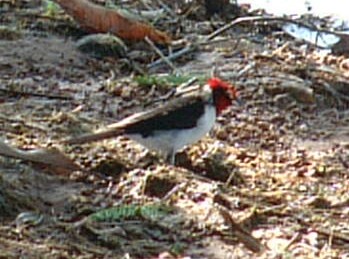 |
The Red-capped Cardinal is one of the bright birds of Los Llanos, Venezuela. Here, feeding in the mud by a flood-plain in Los Llanos. |
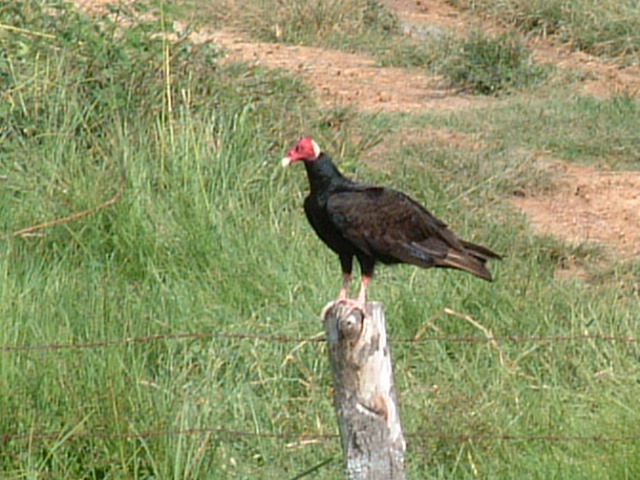 |
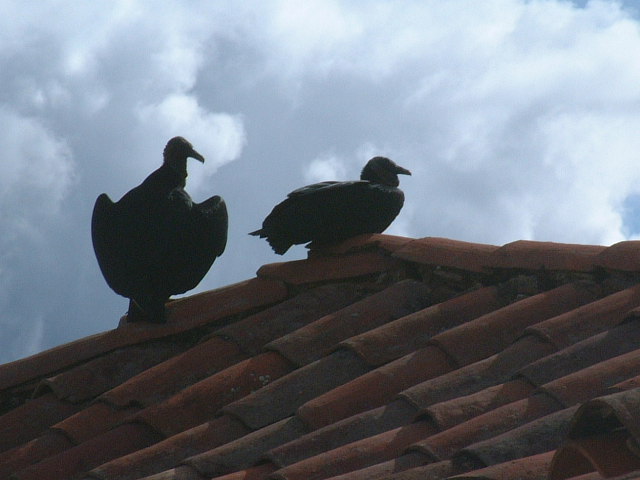
Left is the ubiquitous Turkey Vulture, the same species as in California. Along with the Turkey vulture we saw many Osprey, Lesser Yellow-Headed and Black Vultures (right). The Black Vulture took the place of seagulls on some of the beaches off the coast of Venezuela -- large flocks hopping about, picking at the flotsam and jetsam. Other large raptors we often saw in Venezuela were the Yellow-Headed Caracara and the Crested Caracara, with its long legs. |
 |
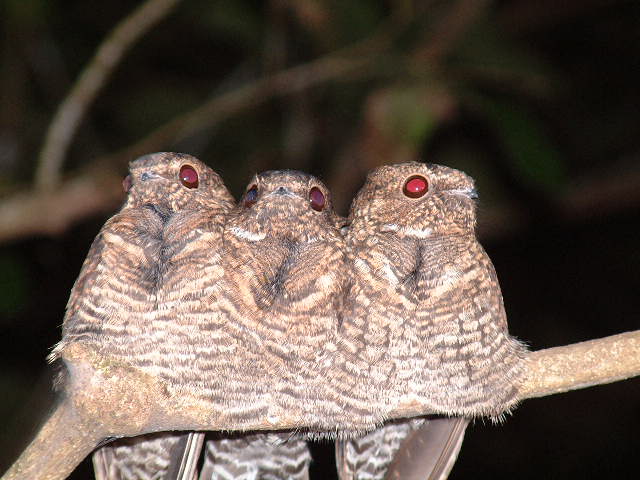
| Band-tailed Nighthawks are one of the few nighthawks to perch horizontally on a branch, often in groups up to a dozen, all facing the same direction. We came upon these on our night excursion on the Apure River of Venezuela. The photo, unfortunately, cuts off the white band on their tails. |
 |
 |
Black Skimmers are fascinating water birds. They open those long bills and scoop the fish from the water while flying over. We saw them not only in the fresh water habitat of Los Llanos, but in the saltwater Golfo de Cariaco on Venezuela's Caribbean coast. |
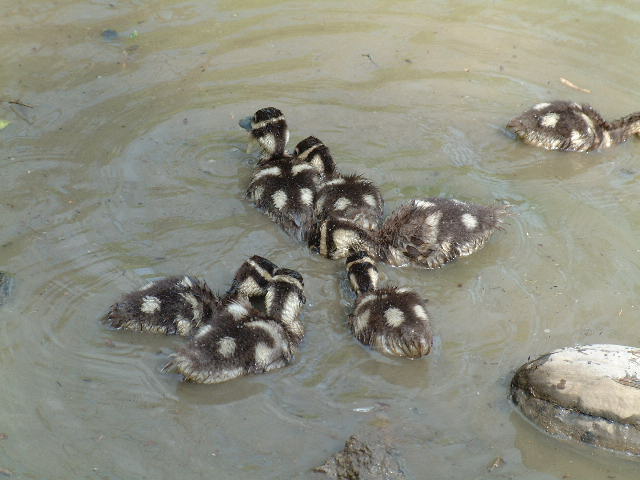 Probably white-faced whistling ducklings |
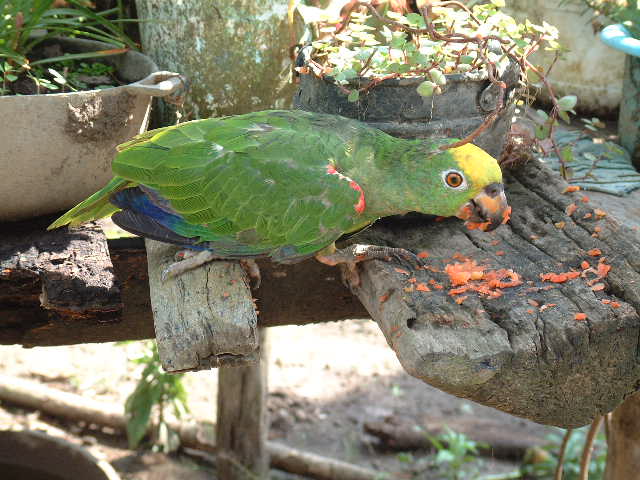 Yellow-headed parrot on a river farm, Venezuela. |
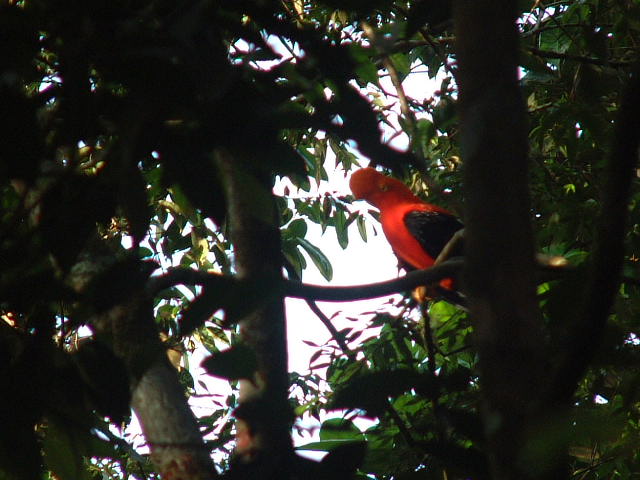
| High in the Venezuelan Andes we combined birding with hiking and riding. The reward for a 4 hour hike in cloud forest starting at 5 am at 2,400m (8,000 ft) was a chance to see, hear, and photograph the very rare Andean Cock of the Rock, about 12‑14 inches tall. The terribly sad thing was, the birds were wary as we approached. We saw why, when we picked up spent shotgun cartridges from the trail. |
 |
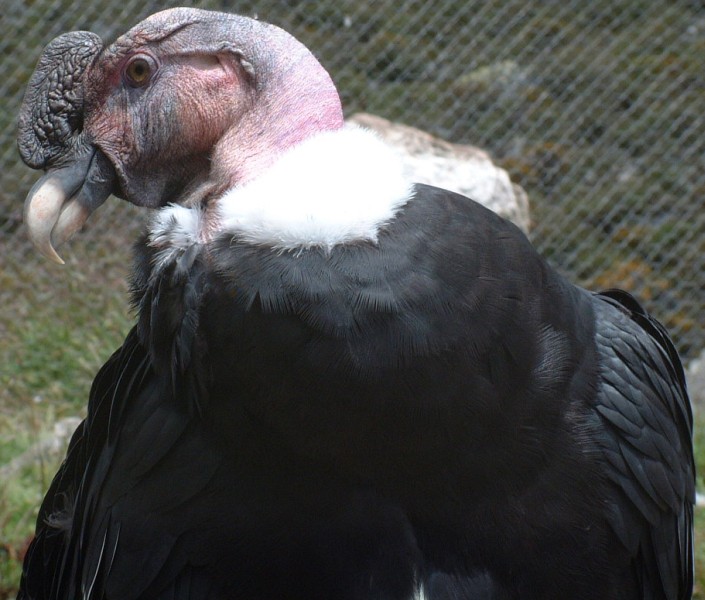 |
Well, we didn't see any in the wild, though reportedly there are a dozen wild Andean Condors now living around the Merida region of Venezuela. This massive male is captive in a national park sanctuary established to re-introduce the condor to Venezuela. The wing span is over 12 feet (2m) wide! |

Top Level: Home | Destinations | Cruising Info | Underwater | Boat Guests | Ocelot | Sue | Jon | Amanda | Chris | Site Map | Make a Comment
|
If our information is useful, you can help by making a donation |
Copyright © 2000‑ Contact: Jon and Sue Hacking -- HackingFamily.com, svOcelot.com. All rights reserved.
 as there is some overlap, but mainly our reference is
 by Schauensee and Phelps, published 1978, Princeton University Press.
It has fantastic color plates, but, in our opinion, not enough. Hundreds of
species are illustrated by black and white line drawings in the text
section, making it a bit of a puzzle to find and identify new birds.
This book needs a new version, and soon. In any case, minor grouches
aside, we've had a fabulous time both inland and along the coasts,
binoculars and bird book in hand.
by Schauensee and Phelps, published 1978, Princeton University Press.
It has fantastic color plates, but, in our opinion, not enough. Hundreds of
species are illustrated by black and white line drawings in the text
section, making it a bit of a puzzle to find and identify new birds.
This book needs a new version, and soon. In any case, minor grouches
aside, we've had a fabulous time both inland and along the coasts,
binoculars and bird book in hand.